
Black History: Special Delivery!!
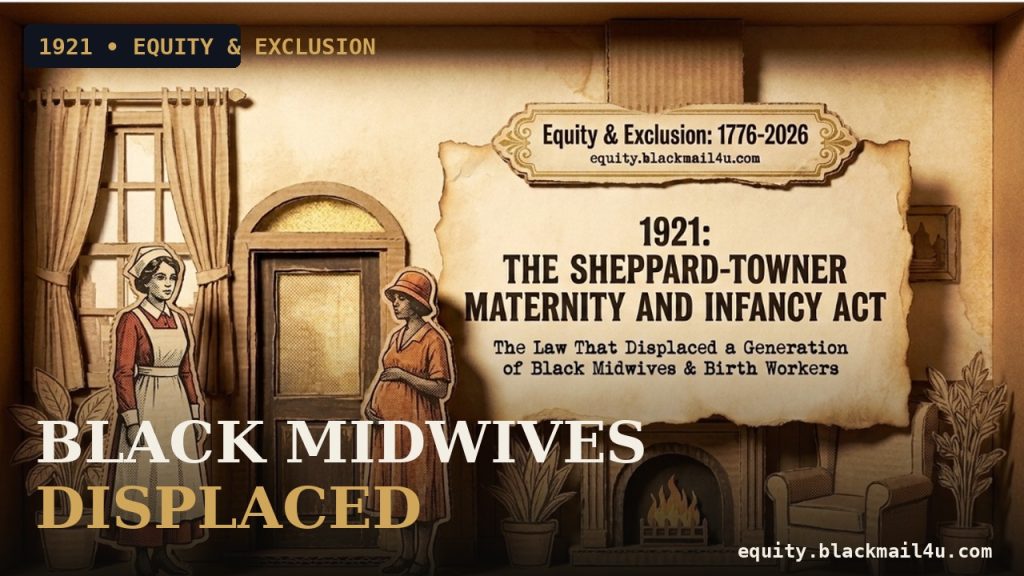
We’re continuing our review of select entries from the Equity & Exclusion archive. Today, let’s look at the 1921 Sheppard-Towner Maternity and Infancy Act.
What the Act Did
Sheppard-Towner was the first federally funded social-welfare program in U.S. history. It provided matching funds to states for maternal and infant health, including prenatal clinics, public health nurses, and training and licensing requirements for midwives. Congress passed it in November 1921, a year after the Nineteenth Amendment enfranchised women, following heavy lobbying by women’s organizations courting the new voting bloc. Rep. Horace Mann Towner and Sen. Morris Sheppard sponsored the bill, and President Warren G. Harding signed it into law.
Each state received at least $5,000 in annual grants from a $1.2 million federal pool. Participation, however, was entirely voluntary — which meant Southern states had full authority to shape implementation on their own terms.
The “Granny Midwives”
In the rural South, Black “granny midwives” delivered an estimated 50 to 75 percent of Black babies. Their knowledge was generational, passed down through communities that white medical infrastructure had never adequately served in the first place.
Licensing as Gatekeeping
Southern states used the Act’s new licensing requirements as a gatekeeping tool. State public health officials characterized granny midwives’ generational expertise as primitive and dangerous in official public health literature; the language of delegitimization was explicit and documented.
By the time Congress let the Act lapse in 1929, after the American Medical Association lobbied against it as federal overreach, midwife-attended births had fallen to just 15 percent of all U.S. births, concentrated almost entirely among Southern Black communities.
Decrease In Access and Availability of Black Health Care Workers
White physicians routinely refused Black patients, and Black medical infrastructure remained severely underfunded. The same licensing framework that pushed out granny midwives also blocked Black clinicians from professional certification, excluded them from historically white professional associations, including the American Medical Association, and prevented them from practicing in segregated hospitals.
The damage also compounded an earlier blow: the 1910 Flexner Report, a Carnegie Foundation-commissioned survey of U.S. medical education that triggered the closure of most historically Black medical schools. Together, these two events stripped Black communities of both their traditional birth workers and their pipeline to formally trained Black physicians, a compounded care crisis that federal policy helped create and left without remedy.
Watch the Full Story
This is one of 80 entries in Equity & Exclusion, a sourced, structural review of federal laws, court rulings, and executive orders that have shaped Black life in America from 1776 to 2026. Read the full entry and the rest of the archive at equity.blackmail4u.com.
Another installment of melanated mail has been delivered. Ponder, reflect, and pass it on.