

Black History: Special Delivery!

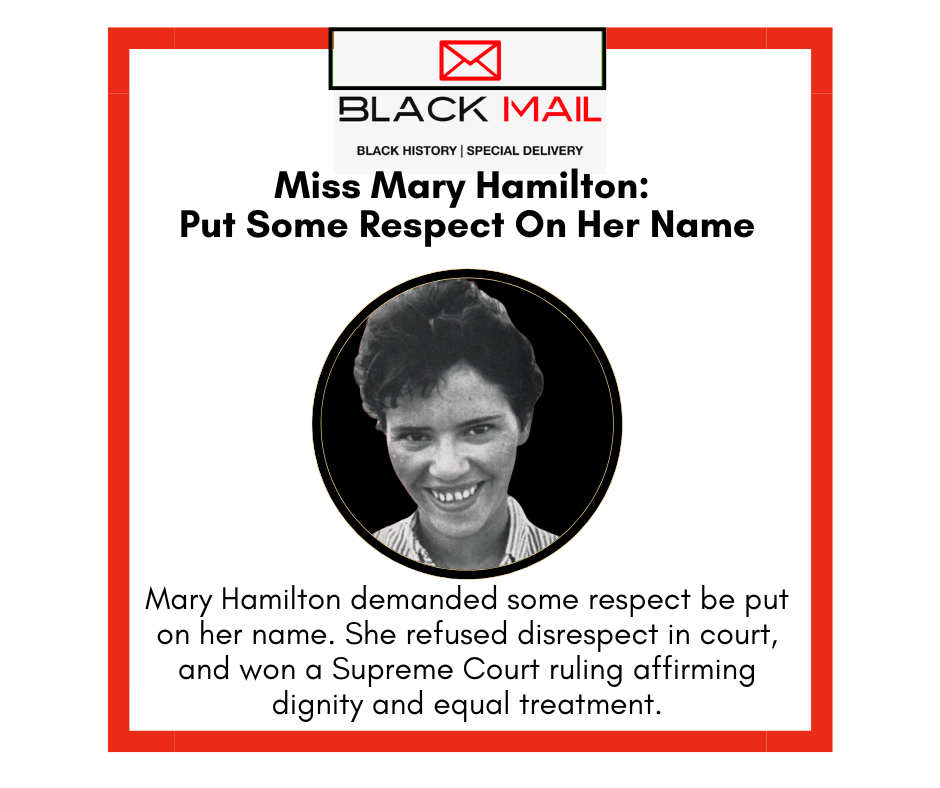
Mary Hamilton was a teacher, a Freedom Rider, and the first female field organizer in the South for the Congress of Racial Equality (CORE). Fierce, disciplined, and unwavering, she was so resolute in her convictions that, according to the book Call Me Miss Hamilton by Carole Boston Weatherford, Dr. Martin Luther King Jr. nicknamed her “Red” for her fiery spirit.

By the early 1960s, Hamilton was deeply involved in civil rights organizing across the South. As a Freedom Rider and CORE field organizer, she worked in communities where protests, voter registration drives, and desegregation efforts often led to arrests. Activists in these spaces regularly faced jail time, harassment, and violence. Hamilton was no exception.
In 1963, during protests in Gadsden, Alabama, Hamilton was arrested along with other demonstrators. At a court hearing that June, the prosecutor addressed her simply as “Mary,” following a common Jim Crow practice of denying Black adults formal titles like “Miss” or “Mr.” White witnesses, however, were addressed respectfully.
During the hearing, Hamilton refused to answer until she was called “Miss Hamilton.”

When she refused to respond, the judge found her in contempt of court and sentenced her to five days in jail and a fifty-dollar fine.
What may seem like a small act was, in reality, a direct challenge to the racial caste system embedded in everyday Southern life.
The NAACP Legal Defense Fund supported her appeal, and in 1964, the U.S. Supreme Court overturned her conviction in Hamilton v. Alabama. The Court ruled that racially discriminatory forms of address violated the Equal Protection Clause of the Fourteenth Amendment. The decision affirmed that everyone in court is entitled to equal courtesy and respect.

The case became informally known as the “Miss Mary Case.” Though it is often a footnote in civil rights history, its impact was lasting. Today, courtroom norms require equal forms of address regardless of race, in part because of the precedent her case set.
Like many women in the Civil Rights Movement, Mary Hamilton did not become a nationally celebrated figure. Historians note that women carried much of the day-to-day organizing work of the movement, even as public attention focused primarily on male leaders. Hamilton returned to a more private life after her victory and died in 2002.
Still, Mary Hamilton’s stand in that Alabama courtroom remains powerful. She was not asking for special treatment. She demanded that they put some respect on her name.
Another installment of Melanated Mail has been delivered. Ponder, reflect, and pass it on.


