Black History: Special Delivery!
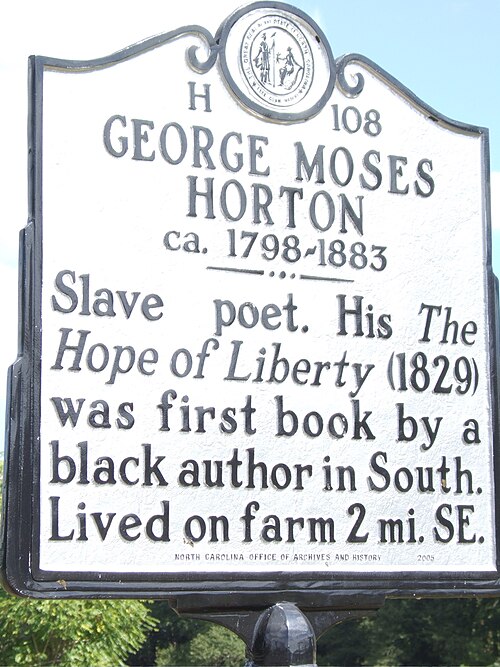
In the early nineteenth century, while still enslaved in North Carolina, George Moses Horton used poetry as both expression and resistance. Long before freedom came, he was writing toward it. His words carried longing, faith, and protest, making him one of the most remarkable literary voices of his time.
Born enslaved in Northampton County around 1797, Horton became the first enslaved Black person in the South to publish a book. His 1829 collection The Hope of Liberty secured his place in American literary history.
Love for Sale
As a young man, Horton negotiated to hire his own time from his enslaver so he could travel to Chapel Hill to sell fruit at a market near the University of North Carolina. There, students noticed his unusual vocabulary and gift for poetry.
They began commissioning him to write love poems and personalized acrostics for their sweethearts. Word spread across campus. Horton built a following. His reputation reached influential figures, including North Carolina Governor John Owen and abolitionist editor William Lloyd Garrison.
By today’s standards, Horton would be considered a working creative with a following, building an audience through the power of his voice.
Self-Taught and Determined
Horton taught himself to read using a Bible and a Methodist hymnal. Before he could write fluently, he composed entire poems in his head while working in the fields, memorizing them and reciting them for others to transcribe.
Some of his early poems were published with the help of novelist Caroline Lee Hentz, who assisted in preparing his verses for print.
He was sometimes called the “sable bard” of North Carolina and is often described as one of the first professional Black poets in America.
Publishing as a Bid for Freedom
In publishing The Hope of Liberty, Horton hoped book sales and public support might allow him to purchase his freedom. They did not.
One of the most powerful poems from that collection, “The Slave’s Complaint,” captures the anguish of bondage. Here is an excerpt:
Am I sadly cast aside,
On misfortune’s rugged tide?
Will the world my pains deride
Forever?
The repeated word “Forever” echoes the fear that suffering might never end, even as the poem reaches toward hope.
Despite publishing multiple collections, Horton remained enslaved until 1865. Freedom came not through literary income but through the Civil War.
Freedom and the Final Chapter
When Union troops moved through North Carolina near the war’s end, Horton left with them and traveled north alongside the Ninth Michigan Cavalry, a Union regiment operating in connection with United States Colored Troops during emancipation efforts in the region. Already in his late sixties, he eventually settled in Philadelphia.
There, he wrote religious and Sunday school materials and worked to support himself. He continued writing poetry, including reflections on discrimination he faced as a free Black man.
He died in Philadelphia in 1883. The details of his death remain unclear, and his burial place is unknown.
When modern lyrical and spoken-word artists stand before an audience, they continue a legacy and language of liberation that Horton helped shape. His life reminds us that poetry has long been a pathway to express both love and lament.
Another installment of Melanated Mail has been delivered. Ponder, reflect, and pass it on.