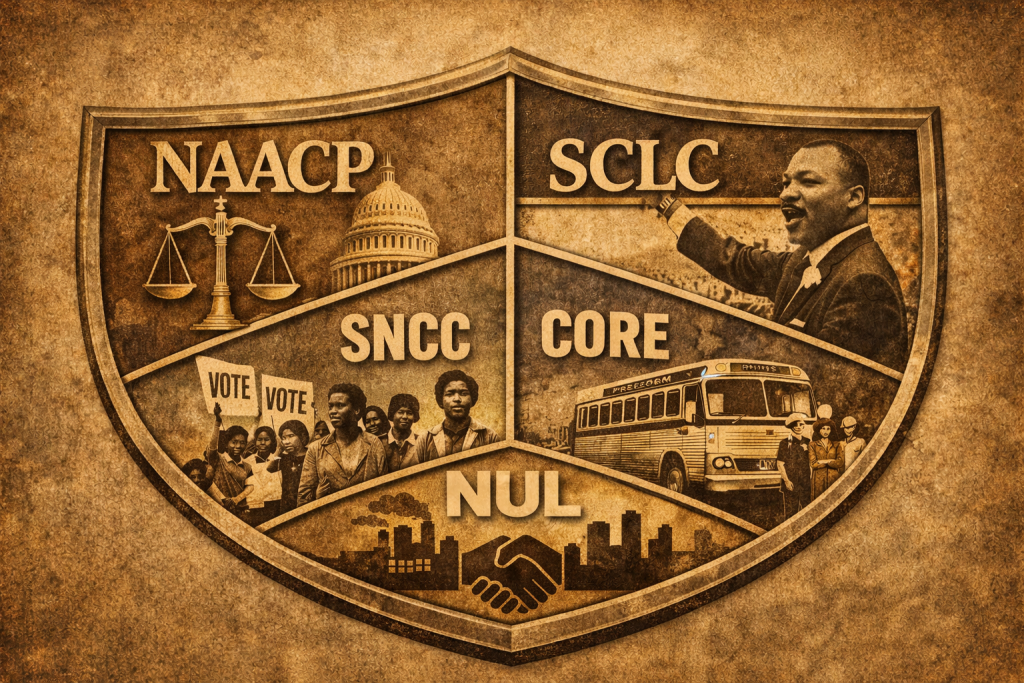
During the height of the Civil Rights Movement, five major national organizations helped dismantle segregation and expand democratic rights. Historians sometimes refer to them collectively as the “Big Five”:
- National Association for the Advancement of Colored People (NAACP)
- Southern Christian Leadership Conference (SCLC)
- Student Nonviolent Coordinating Committee (SNCC)
- Congress of Racial Equality (CORE)
- National Urban League
They were not a formal coalition, yet together they shaped the movement’s strategy and momentum. Each addressed a different dimension of racial injustice.
National Association for the Advancement of Colored People (NAACP)
Founded in 1909 in response to racial violence and legalized segregation, the NAACP focused on dismantling discrimination through the courts and federal law. Leaders such as W.E.B. Du Bois and Thurgood Marshall helped secure landmark victories, most notably Brown v. Board of Education in 1954. The organization remains active today.
Southern Christian Leadership Conference (SCLC)
Founded in 1957 after the Montgomery Bus Boycott, the SCLC coordinated nonviolent protest campaigns across the South by mobilizing Black churches. Led by Dr. Martin Luther King Jr. and Ralph Abernathy, it helped organize the Birmingham Campaign, the March on Washington, and the Selma Voting Rights Campaign. It still operates, though with less national prominence.
Student Nonviolent Coordinating Committee (SNCC)
Created in 1960 by student activists following the Greensboro sit-ins, SNCC focused on grassroots organizing and voter registration in the Deep South. Leaders such as John Lewis and Diane Nash emphasized local empowerment and participatory democracy. SNCC was central to Freedom Summer and the Mississippi Freedom Democratic Party. Ideological divisions, financial strain, and federal surveillance contributed to its dissolution in the 1970s.
Congress of Racial Equality (CORE)
Founded in Chicago in 1942, CORE employed nonviolent direct action to challenge segregation. Under leaders like James Farmer, it organized the Freedom Rides of 1961. Leadership shifts and ideological changes later reduced its national influence. It still exists in limited capacity.
National Urban League
Established in 1910, the National Urban League focused on economic justice, employment discrimination, and housing inequality. Leaders such as Whitney Young expanded their national reach through corporate partnerships and policy advocacy. It remains active today.
Partners or Competitors?
The Big Five sometimes competed for funding, media attention, and political influence. Younger activists criticized older organizations as too cautious, and disagreements emerged over the meaning and limits of nonviolence.
Yet they also collaborated. They worked together on the March on Washington and collectively pressured federal officials, helping secure passage of the Civil Rights Act of 1964 and the Voting Rights Act of 1965.
Racism in America operated through legal systems, economic structures, political institutions, and violence. No single organization or strategy could dismantle something so deeply embedded. Each group faced its own challenges and limitations, yet their varied approaches ultimately strengthened the broader movement.
Black Women and the Architecture of the Movement
Black women were central to organizing, education, and strategy across all five organizations, though they were often not appointed to top formal leadership positions or elevated to national spokesperson roles.
Septima Clark, who directed the Citizenship Education Program for the Southern Christian Leadership Conference (SCLC), trained thousands of Black voters across the South.
Dorothy Height, president of the National Council of Negro Women, worked alongside leaders of the NAACP, SCLC, and the National Urban League and helped organize the March on Washington, though she was not invited to speak.
Gloria Richardson led the Cambridge Movement in Maryland and collaborated closely with SNCC organizers, challenging both segregation and gendered expectations of leadership.
These courageous Black women leaders remind us that many of the most transformative contributions happened outside the spotlight.
Enduring Impact
SNCC dissolved in the 1970s. The NAACP and the National Urban League continue to operate at the national level, whereas SCLC and CORE remain active but have less public visibility than during the peak of the Civil Rights Movement.
The Civil Rights Movement was not driven by a single organization, leader, or method. Together, these organizations reshaped the nation’s civic and social landscape.
Another installment of Melanated Mail has been delivered. Ponder, reflect, and pass it on.
References
1. National Park Service on the Southern Christian Leadership Conference (SCLC)
U.S. National Park Service. (n.d.). Southern Christian Leadership Conference (SCLC). U.S. Department of the Interior. https://www.nps.gov/subjects/civilrights/sclc.htm (National Park Service)
2. Stanford King Institute on the NAACP and Civil Rights Collaboration
National Association for the Advancement of Colored People. (n.d.). NAACP history and partnerships. Stanford University Martin Luther King, Jr. Research and Education Institute. https://kinginstitute.stanford.edu/national-association-advancement-colored-people-naacp (King Institute)
3. History.com on the Student Nonviolent Coordinating Committee (SNCC)
HISTORY.com Editors. (2009, November 12; updated May 28, 2025). SNCC. A&E Television Networks. https://www.history.com/articles/sncc (HISTORY)
4. National Humanities Center on Civil Rights Movement Organizations
National Humanities Center. (n.d.). The Civil Rights Movement: 1919–1960s. https://nationalhumanitiescenter.org/tserve/freedom/1917beyond/essays/crm.htm (nationalhumanitiescenter.org)
Congress of Racial Equality (CORE) Primary History Overview
Civil Rights Movement Archive. (n.d.). Congress of Racial Equality (CORE). https://www.crmvet.org/tim/timcore.htm (crmvet.org)